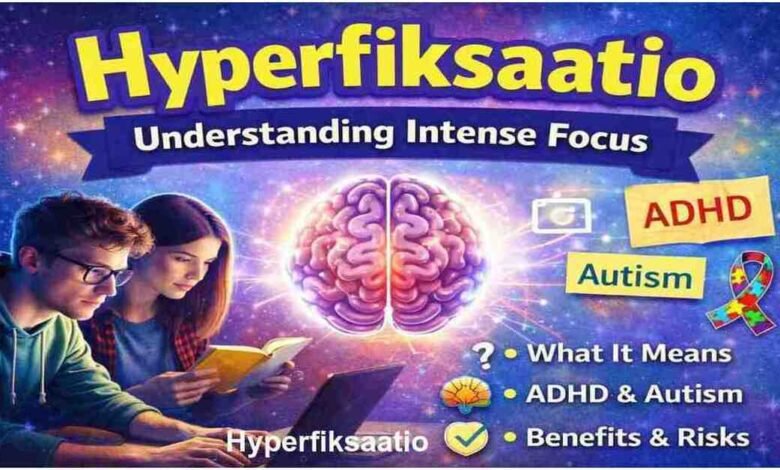
In recent years, more people have searched for the term Hyperfiksaatio to describe a powerful and sometimes overwhelming form of deep focus. Social media discussions, mental health forums, and neurodiversity communities have made the word more visible. Yet many people still feel confused about what it truly means, how it connects to ADHD or autism, and whether it is helpful or harmful.
This guide explains hyperfiksaatio in clear and simple language. It explores the psychology behind intense focus, its benefits and risks, and how it differs from related traits such as special interests. The goal is not to label or diagnose, but to help you understand the experience in a balanced and evidence-based way.
What Is Hyperfiksaatio
The Hyperfiksaatio meaning refers to an intense, prolonged focus on a specific activity, topic, or even a person. During this period, attention becomes so strong that it may feel difficult to shift away. A person may lose track of time, forget basic needs such as eating or resting, and become fully absorbed in what they are doing.
This type of focus is stronger than normal concentration. Most people can focus deeply when motivated, but hyperfiksaatio often feels automatic and hard to control. It can last hours, days, or even longer depending on the situation.
Some people search for “Hyperfiksaatio adalah,” especially in multilingual contexts. The word adalah simply means “is” in Indonesian, so the phrase translates to “Hyperfiksaatio is.” This shows that the concept is being explored globally, not only in English-speaking countries.
Although the word itself may sound technical, the experience is common among many individuals, especially those who are neurodivergent.
How Hyperfiksaatio Appears in Daily Life
Hyperfiksaatio can show up in different ways depending on personality, environment, and brain wiring. For some, it centers around hobbies or creative projects. For others, it may involve relationships or specific goals.
When hyperfiksaatio is focused on a hobby, it can look like spending hours researching a topic, practicing a skill repeatedly, or consuming large amounts of information. A person might suddenly become deeply interested in photography, coding, fitness, gaming, or learning a new language. During this phase, motivation feels strong and natural.
Hyperfiksaatio on a person can feel more emotional. Someone might think about that individual constantly, analyze conversations repeatedly, or prioritize that relationship above other responsibilities. This does not always mean obsession in a clinical sense, but it can become emotionally intense.
The key feature is difficulty shifting attention. Even when responsibilities call, the mind may resist moving away from the focus area.
The Connection Between Hyperfiksaatio and ADHD
One of the most discussed topics online is Hyperfiksaatio ADHD. ADHD, or Attention-Deficit/Hyperactivity Disorder, affects how the brain manages attention and impulse control. Many people assume ADHD only involves distraction, but that is not entirely accurate.
ADHD is often linked to differences in dopamine regulation. Dopamine is a brain chemical connected to motivation and reward. When an activity provides strong stimulation or interest, the ADHD brain can “lock in” intensely. This is why some individuals with ADHD experience periods of extreme productivity in tasks they find exciting.
However, this deep focus does not always appear on demand. Tasks that feel boring or repetitive may still be difficult to start or complete. This contrast between distraction and intense focus can feel confusing, especially for those newly learning about ADHD.
It is important to note that hyperfiksaatio is not exclusive to ADHD. It can also appear in people without a formal diagnosis. Brain chemistry varies widely, and intense focus can happen across different personality types and neurological profiles.
Hyperfiksaatio vs Special Interest
Another common comparison is Hyperfiksaatio vs special interest. These two experiences share similarities but are not identical.
Special interests are most often associated with autism spectrum conditions. They usually involve long-term, stable interests that remain consistent over years. An autistic person may develop deep expertise in a subject and maintain that passion over a lifetime.
Hyperfiksaatio, especially in ADHD, often shifts more frequently. A person might intensely focus on one topic for weeks or months and then move on to another. The emotional intensity can be high, but the duration may be shorter.
Both experiences involve deep focus and strong motivation. The difference lies mainly in consistency and stability over time. Neither is inherently negative. In many cases, both lead to skill development, creativity, and personal satisfaction.
Benefits of Hyperfiksaatio
While intense focus can create challenges, it also offers significant benefits. Many people achieve impressive results during periods of hyperfiksaatio.
Deep concentration allows rapid skill development. Someone learning graphic design, programming, music, or writing may improve quickly because they invest large amounts of focused practice. This type of immersion often resembles what psychologists call a “flow state,” where a person becomes fully absorbed and highly productive.
Innovation can also emerge from intense focus. Many entrepreneurs, artists, and researchers describe becoming completely immersed in their work for extended periods. This immersion can produce creative breakthroughs and detailed problem-solving.
In academic settings, hyperfiksaatio can help students master complex topics. The ability to dive deeply into research often leads to high-level understanding.
The key is balance. When managed carefully, intense focus becomes a powerful strength rather than a burden.
Challenges and Risks
Despite its advantages, hyperfiksaatio can create difficulties if it disrupts daily functioning. One of the most common challenges is neglecting physical needs. People may forget to eat, sleep, or take breaks.
Another risk is burnout. After extended periods of intense focus, energy levels may drop sharply. This cycle of extreme productivity followed by exhaustion can feel frustrating.
Social relationships may also be affected. If attention is constantly directed toward one interest or person, other connections may receive less care.
In some cases, hyperfiksaatio can increase stress. When responsibilities pile up because attention remains fixed elsewhere, anxiety may grow. Recognizing early warning signs helps prevent these issues from escalating.
Psychological Explanation Behind Intense Focus
From a scientific perspective, intense focus involves the brain’s reward system. When an activity feels stimulating or meaningful, dopamine levels increase. This reinforces the behavior and encourages continued engagement.
Executive functioning, which includes planning and shifting attention, also plays a role. In ADHD, executive functioning differences can make it harder to switch tasks once attention is locked in.
The experience can feel similar to a flow state, but hyperfiksaatio often involves reduced flexibility. Flow usually occurs during challenging yet controlled tasks, while hyperfiksaatio may continue even when external demands require a shift.
Understanding the brain mechanisms helps reduce self-blame. Intense focus is not a character flaw. It is linked to neurological processes that vary among individuals.
When Hyperfiksaatio Becomes a Concern
Hyperfiksaatio becomes concerning when it interferes significantly with daily life. Warning signs include repeated missed deadlines, damaged relationships, severe sleep disruption, or emotional distress tied to the focus area.
If intense focus feels uncontrollable or leads to negative mental health effects, consulting a licensed mental health professional can provide clarity. A professional can assess whether ADHD, autism, anxiety, or another condition may be contributing factors.
Self-diagnosis through online content is not recommended. Reliable assessment requires a comprehensive evaluation.
Healthy Ways to Manage Hyperfiksaatio
Managing intense focus does not mean eliminating it. Instead, the goal is to create balance.
Setting time boundaries can help. Using alarms or scheduling tools reminds the brain to pause. Short breaks protect physical and mental health.
Accountability systems, such as sharing goals with a friend or colleague, encourage balanced attention. Mindfulness practices can also improve awareness of when focus becomes excessive.
For individuals with ADHD, professional treatment options such as behavioral therapy or medication may support better attention regulation.
The objective is not to reduce passion but to channel it in sustainable ways.
Frequently Asked Questions
Is hyperfocus ADHD or autism? Hyperfocus is commonly associated with ADHD, but it can also appear in autism. The pattern and duration may differ depending on the individual.
How long do ADHD hyperfixations last? They can last hours, days, or months. Duration varies widely and often shifts once the interest loses novelty.
Are hyperfixations ADHD or autism? They are more frequently discussed in ADHD, but autistic individuals may experience similar intense focus, often in the form of long-term special interests.
What do autistic hyperfixations look like? Autistic special interests usually involve deep, consistent focus on specific topics. The person may develop advanced knowledge and feel comfort through the interest.
Summary
Hyperfiksaatio is not simply distraction or obsession. It is a complex attention pattern rooted in brain chemistry, motivation, and personality. For some, it fuels creativity and growth. For others, it requires careful management to avoid imbalance.
Understanding how your mind works empowers you to use intense focus wisely. With self-awareness, structure, and support when needed, hyperfiksaatio can become a strength rather than a struggle.
You May Also Like: Phil or Lil of Rugrats Crossword Complete Answer Guide