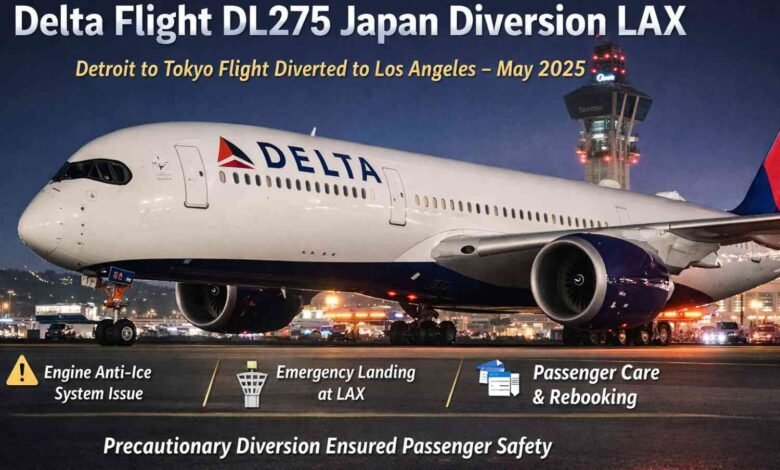
When Delta Flight DL275 began its long journey from Detroit to Tokyo, no one expected the routine trans-Pacific trip to turn into a carefully managed diversion at LAX. Yet the unexpected change of course revealed something powerful about modern aviation — safety always comes first. The decision behind the Japan diversion was not about panic, but precision. From cockpit monitoring to coordinated ground response at Los Angeles International Airport, every step reflected disciplined planning. What could have been seen as a disruption instead became a clear example of how airlines protect passengers, aircraft, and long-haul operations when it matters most.
Delta Flight DL275 Japan Diversion LAX Incident Analysis
When covering Delta Flight DL275, the focus naturally centers on the unexpected diverted LAX situation that turned a routine Japan diversion story into a major aviation incident in May 2025. What began as a standard long-haul flight from Detroit to Tokyo quickly shifted course toward Los Angeles International Airport, changing what should have been a smooth trans-Pacific journey into an emergency landing scenario shaped by a critical safety decision.
From my experience analyzing airline operations, these moments reveal more about systems and planning than routine flights ever could. The airline response, the scale of passenger disruption, and the broader operational impact all highlight how modern aviation prioritizes safety over schedule. While travelers saw inconvenience, professionals saw structured execution.
Flight Route and Aircraft Overview
The flight was scheduled to depart from Detroit Metropolitan Wayne County Airport (DTW) and arrive at Tokyo Haneda Airport (HND) as part of a daily international service operated by Delta Air Lines. The aircraft assigned was the Airbus A350-900, a modern long-range aircraft specifically designed for trans-Pacific operations.
The journey typically spans a 13-hour journey, connecting the Midwest to Asia on an important overseas route serving a major Asia destination. On this day, a departure delay caused by a inbound aircraft slightly shifted the timeline, but nothing initially suggested disruption. Flights between Detroit and Tokyo are routine within Delta’s long-haul network, and the aircraft’s design supports endurance, efficiency, and passenger comfort across oceanic distances.
Technical Cause Behind the Diversion
The core issue was linked to the engine anti-ice system, a critical safety component within the aircraft’s design. Reports indicated a technical malfunction affecting one of the Rolls-Royce Trent XWB engines. These engines power many Airbus A350 aircraft and are built to operate reliably at high altitudes, including around 38,000 feet.
During the flight path over the North Pacific near the Bering Sea, conditions can create ice buildup, even when skies appear clear. If ice accumulates, it may cause airflow disruption and reduce engine performance. While the aircraft was approximately 620 nautical miles southwest of Anchorage Alaska, the crew observed abnormal behavior related to the system.
In such extreme environments, aviation guidelines are clear. A precautionary measure is required under strict aviation protocols whenever a system tied to engine reliability shows irregular signs. Continuing across remote Pacific airspace without full confidence in the system would have increased risk. From an operational standpoint, diverting was not dramatic—it was disciplined.
Why LAX Was Selected as Diversion Airport
Although geographically closer airports existed, Los Angeles International Airport LAX stood out due to its infrastructure. As a major Delta hub on the West Coast location, LAX provides immediate access to advanced maintenance facilities and 24/7 technical support.
Importantly, the airport offers direct access to Rolls-Royce engine specialists familiar with Trent XWB tooling and equipped with proper parts inventory. That means faster inspection capability and streamlined repair logistics. In addition, LAX supports full customs and immigration processing, ensuring smoother passenger rebooking and access to multiple onward Asia flights within Delta’s U.S. connectivity network.
From an operational perspective, this decision minimized downtime and positioned the aircraft where solutions—not temporary fixes—were available.
In-Flight Crew Response and Landing Details
Once the issue was identified, flight crew actions followed structured procedure. Pilots monitored engine systems, maintained constant air traffic control communication, and initiated Delta Operations Center coordination. The objective was clear: chart the safest diversion route while maintaining passenger confidence.
Cabin teams handled cabin preparation, ensuring travelers were informed and ready for the unscheduled arrival. The aircraft ultimately landed on Runway 06R at approximately 1:38 AM May 28 2025, completing roughly 12 hours total air time. Importantly, no injuries reported confirmed that the approach and landing were stable and controlled.
Upon arrival, maintenance crews and emergency planning teams were already in place, demonstrating how coordinated airline systems activate instantly when irregular operations occur.
Passenger Handling and Airline Support
For travelers, the event brought both inconvenience and reassurance. Delta provided meals and refreshments, arranged hotel accommodations, and organized rebooking flights to Tokyo or alternative Delta hub connections. Additional ground transportation support and consistent customer service updates helped reduce uncertainty.
What stood out was the level of transparent communication. While disrupted travel plans are frustrating, clarity often makes the difference. In my observation, passengers respond better when they understand the reasoning behind operational decisions rather than being left guessing.
Operational Aftermath and Aviation Implications
Following arrival, the aircraft was placed in a aircraft grounded status. Certified engineers inspection began immediately, focusing on full anti-ice system repair before any return to service approval. Safety standards require detailed documentation and validation prior to restoring long-haul operations.
Meanwhile, flight rescheduling efforts moved quickly. Some passengers were arranged through alternate Tokyo transfers, others via LAX departures, and a few required Detroit reroute planning. Such flexibility reflects how airlines manage operational disruption while maintaining a broader long-haul safety emphasis.
These events reinforce how precautionary aviation decisions and strategic hub routing are not signs of failure but signs of system strength. Aviation depends on redundancy, infrastructure, and trained judgment under pressure.
Conclusion
The story of Delta Flight DL275 and its diverted LAX landing during this Japan diversion underscores the reality of complex airline operations. What appeared publicly as an unexpected change was internally a calculated safety decision rooted in data, training, and established protocol. The swift airline response, careful management of passenger disruption, and containment of operational impact demonstrate how modern aviation protects travelers—even when it means altering course mid-flight.
In aviation, safety margins are not optional—they are layered. This incident at Los Angeles International Airport serves as a reminder that behind every long-distance flight lies a network prepared for the unexpected.
Faqs
- Why was Delta Flight DL275 diverted to LAX?
Delta Flight DL275 was diverted to Los Angeles International Airport (LAX) due to a technical issue involving the aircraft’s engine anti-ice system. As a precautionary safety measure, the crew chose to land at LAX instead of continuing the trans-Pacific flight to Tokyo.
- When did the Delta Flight DL275 Japan diversion happen?
The diversion occurred in May 2025. The flight departed from Detroit and later changed course, landing safely at LAX in the early hours of May 28, 2025.
- What aircraft was operating Delta Flight DL275?
The flight was operated using an Airbus A350-900, a long-range aircraft commonly used for international and trans-Pacific routes between the United States and Asia.
- Why was Los Angeles International Airport chosen as the diversion point?
LAX was selected because it is a major Delta hub with advanced maintenance facilities, Rolls-Royce engine support, strong passenger rebooking options, and full customs and immigration services.
- Were passengers safe during the DL275 diversion to LAX?
Yes, the aircraft landed safely and no injuries were reported. Delta provided assistance including rebooking, accommodations, meals, and customer service support to minimize passenger disruption.
Read more: Social Media Girls Forum: Proven Guide to Success